
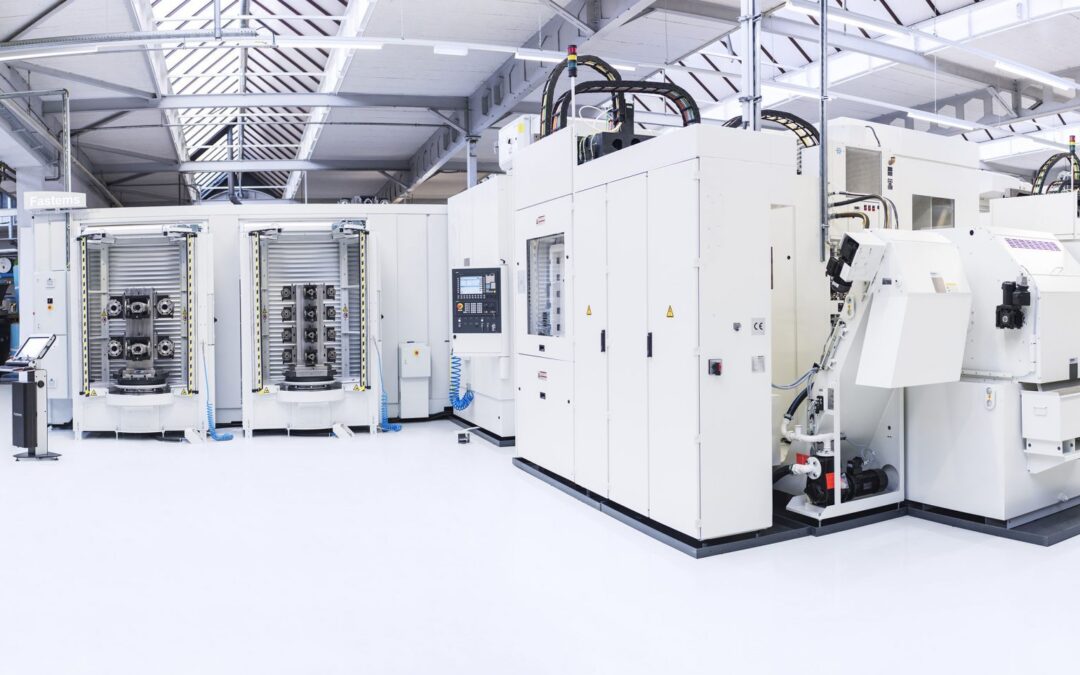
The global manufacturing landscape is shifting rapidly as industries push toward faster output, higher precision, and lower operational costs. In this era of digital transformation, automation-ready CNC cells have emerged as the new backbone of high-volume production lines. These integrated manufacturing units combine advanced CNC machines, robotics, intelligent material handling, and real-time data systems to create a seamless, high-efficiency production ecosystem. Unlike conventional standalone CNC machines that depend heavily on manual intervention, automation-ready CNC cells are engineered for continuous, autonomous operation with minimal downtime. Their purpose is simple yet powerful: to enable manufacturers to scale production without sacrificing accuracy, quality consistency, or operational flexibility. As the demand for mass customization grows across sectors like automotive, aerospace, medical devices, industrial components, and consumer electronics, automation-ready CNC cells provide the foundation for smarter, faster, and more profitable manufacturing. Their ability to perform uninterrupted machining, quality inspection, part loading, unloading, sorting, and even tool management makes them essential for factories seeking to compete in the high-volume global market.
Central to the value of automation-ready CNC cells is the combination of precise machining technology with advanced robotic automation. Industrial robots or collaborative robots (cobots) form the operational backbone of these systems, taking over repetitive tasks such as part handling, fixture loading, pallet changes, and machine tending. In high-volume production lines, manual labor often becomes a bottleneck, especially as cycle times decrease and machine uptime becomes a priority. Robots eliminate these constraints by operating with perfect repeatability, maintaining fast cycle times without fatigue, and ensuring consistent alignment of workpieces for every machining process. In some CNC cells, multi-axis robotic arms work in synergy with automated fixtures that adjust positions in real time, allowing complex parts to be machined in several orientations without requiring manual repositioning. Additionally, robots that integrate machine vision systems enable part recognition, orientation detection, and adaptive handling—capabilities that significantly reduce errors while improving throughput. This blend of robotics and CNC technology creates a fully synchronized production environment where machining, movement, and inspection occur with near-perfect timing and precision.
Efficiency in high-volume production is not only about speed but also the ability to maintain consistent quality across thousands or millions of parts. This is where automation-ready CNC cells demonstrate exceptional advantage through integrated quality control and real-time monitoring. Unlike traditional production environments where quality inspection occurs after machining, automated CNC cells incorporate inline and near-line inspection technologies directly within the workflow. Computer vision systems, laser scanners, probing tools, and automated coordinate measuring machines (CMMs) detect dimensional variations and surface flaws instantly. If deviations occur, the system can trigger automatic tool compensation, adjust machining parameters, alert operators, or isolate defective parts before they reach later production stages. Additionally, smart CNC cells utilize sensor data—such as spindle vibration, tool load, thermal expansion, and coolant flow—to identify early signs of tool wear or machine instability. This predictive insight allows the system to perform automated tool changes, schedule maintenance in advance, and avoid unplanned downtime. The result is a production line capable of delivering consistent, repeatable quality at high output rates without requiring manual oversight.
One of the most critical advantages of automation-ready CNC cells is their unmatched scalability and adaptability. High-volume manufacturing is not always static; production demands can shift due to market changes, product variations, or customer customization. Traditional CNC setups often struggle with such transitions, requiring extensive setup time, reprogramming, and fixture adjustments. Automation-ready CNC cells, however, are designed to adapt quickly. Using modular cell layouts, plug-and-play robotic systems, flexible fixturing, and CAM software capable of generating new toolpaths rapidly, these cells scale production of different components with minimal disruption. Automated tooling systems further enhance flexibility by managing tool libraries, exchanging tools based on program requirements, and calibrating them automatically. Some advanced CNC cells even integrate multiple machining environments—such as milling, turning, grinding, and polishing—within the same automated workflow. This combination of flexibility and speed reduces lead times dramatically and allows manufacturers to diversify their production lines without sacrificing efficiency. Whether producing thousands of identical components or small batches of custom parts, automation-ready CNC cells ensure continuous output with unparalleled agility.
As smart manufacturing becomes the industry standard, data plays an increasingly vital role in shaping the functionality of automation-ready CNC cells. These systems are equipped with IoT-enabled sensors and machine-to-machine communication interfaces that provide complete visibility into every stage of production. Real-time analytics platforms track parameters such as cutting performance, cycle time, energy consumption, robot movement efficiency, spindle health, and tool life. This data is fed into manufacturing execution systems (MES) and enterprise resource planning (ERP) platforms, enabling managers to make data-driven decisions that optimize productivity, forecast maintenance needs, and plan future capacity. Some advanced CNC cells even utilize artificial intelligence to analyze operational patterns, identify inefficiencies, and automatically adjust machining strategies for improved performance. In high-volume environments where even small improvements in cycle time can produce substantial long-term savings, AI-enhanced CNC cells offer a measurable competitive advantage. Moreover, digital twins—virtual replicas of CNC cells—allow engineers to simulate production scenarios, test new product designs, refine cutting strategies, and optimize workflows before physical implementation. This integration of data intelligence transforms automation-ready CNC cells into fully autonomous production systems capable of self-optimization and continuous improvement.
Ultimately, automation-ready CNC cells represent the future of high-volume production lines, where efficiency, precision, and scalability align to create a new manufacturing standard. As industries move toward lights-out manufacturing—operational environments where machines run autonomously 24/7—these advanced CNC systems provide the essential infrastructure needed to eliminate bottlenecks, reduce labor dependency, and ensure flawless repeatability. They reduce downtime through predictive maintenance, enhance product quality through continuous inspection, and support rapid adaptation through flexible automation. More importantly, they position manufacturers to remain competitive in a global market where speed, cost-efficiency, and perfect consistency are non-negotiable. Companies adopting automation-ready CNC cells today are not simply upgrading machinery—they are transitioning into a new era of smart production, where integrated robotics, intelligent machining, and data-driven decision-making redefine what is possible. In the rapidly evolving world of modern manufacturing, automation-ready CNC cells stand as the foundation of future-ready factories capable of meeting the highest demands of high-volume, high-precision production.