
Achieving a mirror-like finish on CNC-machined metal components has become a defining benchmark for premium manufacturing. Industries such as aerospace, medical devices, automotive engineering, robotics, and luxury consumer goods now demand metal surfaces that exhibit flawless reflectivity, ultra-smooth textures, and near-zero surface imperfections. As design standards grow more sophisticated, CNC post-processing workflows have evolved to deliver optical-grade clarity and exceptional surface uniformity. Mirror polishing is no longer just an aesthetic upgrade—it directly enhances corrosion resistance, improves component longevity, reduces friction, and contributes to overall product performance. Modern SEO trends highlight that engineers, manufacturers, and procurement teams increasingly search for detailed, authoritative content describing how post-processing transforms CNC machining outputs into premium-grade finishes. With advanced polishing techniques, automated finishing tools, and updated machining strategies, manufacturers can create metal surfaces that meet both visual excellence and technical precision.
The foundation of mirror-like polishing begins with proper CNC machining strategies designed to minimize initial surface defects. Even the most advanced polishing workflow will struggle if the CNC-machined part contains deep tool marks, inconsistent feed patterns, or irregular stepovers. Therefore, high-precision machining parameters—such as optimized feed rates, minimized step-down increments, and controlled cutter engagement—are essential for reducing roughness before post-processing begins. Tools such as ball-nose end mills, super-finishing end mills, and single-crystal diamond cutters are frequently used to achieve a starting surface roughness low enough to streamline polishing cycles. Equally important is the use of high spindle speeds, balanced tool holders, and vibration-minimizing tool paths that reduce micro-chatter. Advanced 5-axis machining can achieve superior contouring on complex surfaces, ensuring that polishing teams work on a uniformly machined foundation. The more accurate the initial CNC pass, the fewer hours required for post-processing, making precision machining a vital part of the mirror-finish workflow.
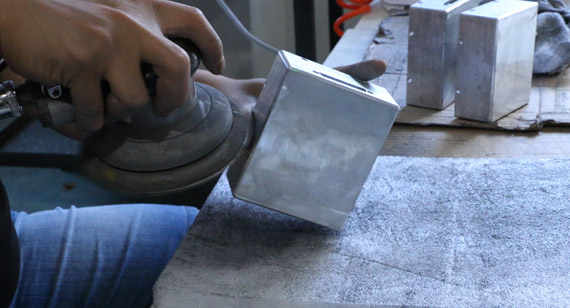
Once machining is complete, mechanical polishing becomes the next major step in the journey toward a mirror-like metal surface. This stage typically begins with abrasive sanding, using progressively finer grit levels to eliminate machining marks and gradually refine the metal’s surface texture. Starting with 400 or 600 grit, operators move through 800, 1200, 1500, and 2000 grit abrasives to progressively flatten the micro-peaks left by CNC tools. For ultra-precision components, abrasive levels may extend into 5000 grit or even higher. Techniques like orbital sanding, rotary polishing, and linear abrasive strokes each serve different geometric profiles, allowing technicians to access tight corners, radiused edges, and free-form contours. Mechanical polishing tools—such as buffing wheels, flap wheels, sanding pads, and pneumatic polishers—play essential roles in this stage. The key to effective mechanical polishing lies in maintaining consistent pressure, avoiding localized overheating, and ensuring that the abrasive path overlaps evenly across the surface. When executed properly, mechanical polishing establishes a smooth, uniform foundation necessary for the subsequent steps of fine polishing and lapping.
As the surface becomes progressively smoother, fine polishing and chemical-assisted finishing begin to elevate the metal to a reflective state. Compounds such as aluminum oxide, cerium oxide, diamond paste, and chromium oxide are carefully applied to buffing wheels or soft pads to achieve ultra-fine surface refinement. Diamond polishing compounds, available in grades as fine as 0.25 microns, are especially effective for achieving optical-grade reflection on metals like stainless steel, titanium, brass, and aluminum. This stage requires precision and patience; excessive pressure can create swirl marks or micro-scratches, while insufficient polishing time can leave the surface slightly hazy. To augment the process, chemical polishing solutions may be used to soften microscopic ridges or remove trace oxidation. Electropolishing, in particular, has become popular for medical, aerospace, and food-grade components due to its ability to deliver ultra-smooth surfaces with minimal mechanical intervention. By removing high points at a microscopic level, electropolishing produces a highly reflective, corrosion-resistant finish that pairs exceptionally well with mechanical finesse. When combined with traditional polishing techniques, the result is a flawless visual reflection and extremely low surface roughness values.
One of the most technologically advanced post-processing methods for achieving mirror-like metal polishing is robotic and automated finishing. With manufacturers increasingly adopting automation to meet global demand, robotic polishing workcells have become essential for ensuring consistency, speed, and repeatability. These robotic systems use force-feedback sensors, adaptive motion control, and multi-axis flexibility to polish complex geometries with remarkable precision. They can maintain consistent pressure throughout the finishing cycle, adjust abrasive levels algorithmically, and track real-time surface data to ensure uniformity. Automated polishing eliminates human variability and dramatically reduces the risk of surface defects caused by inconsistent technique. Additionally, no two metal surfaces behave identically; differences in hardness, grain structure, or machining marks can influence the polishing strategy. Robotic systems equipped with AI-enhanced control software can adapt dynamically to these differences, optimizing tool paths and polishing angles on the fly. This integration of automation not only accelerates polishing operations but also provides manufacturers with the ability to scale production while maintaining premium-grade visual quality.
Looking toward the future, CNC post-processing methods for mirror-like metal polishing will continue to evolve alongside advancements in materials science, machining technology, and digital manufacturing. New super-abrasive materials, such as nano-engineered diamond slurries and nano-ceramic polishing compounds, will offer higher efficiency with even lower abrasion artifacts. Hybrid processes that combine mechanical polishing with laser polishing or plasma-assisted surface smoothing will allow manufacturers to achieve levels of reflectivity previously unattainable through traditional methods. Laser polishing, for example, melts the top surface layer of metal to create a naturally smooth and reflective finish, making it ideal for complex geometries and micro-features. Digital twin simulations will streamline polishing workflows by predicting surface behavior, optimizing post-processing sequences, and reducing manual trial-and-error. As industries demand increasingly flawless surfaces for optical devices, surgical tools, electronic components, and luxury hardware, CNC post-processing will remain indispensable. By mastering both foundational machining strategies and advanced polishing techniques, manufacturers can consistently produce metal components that exhibit mirror-quality brilliance and unmatched precision—setting a new standard for high-end production and modern engineering excellence.