
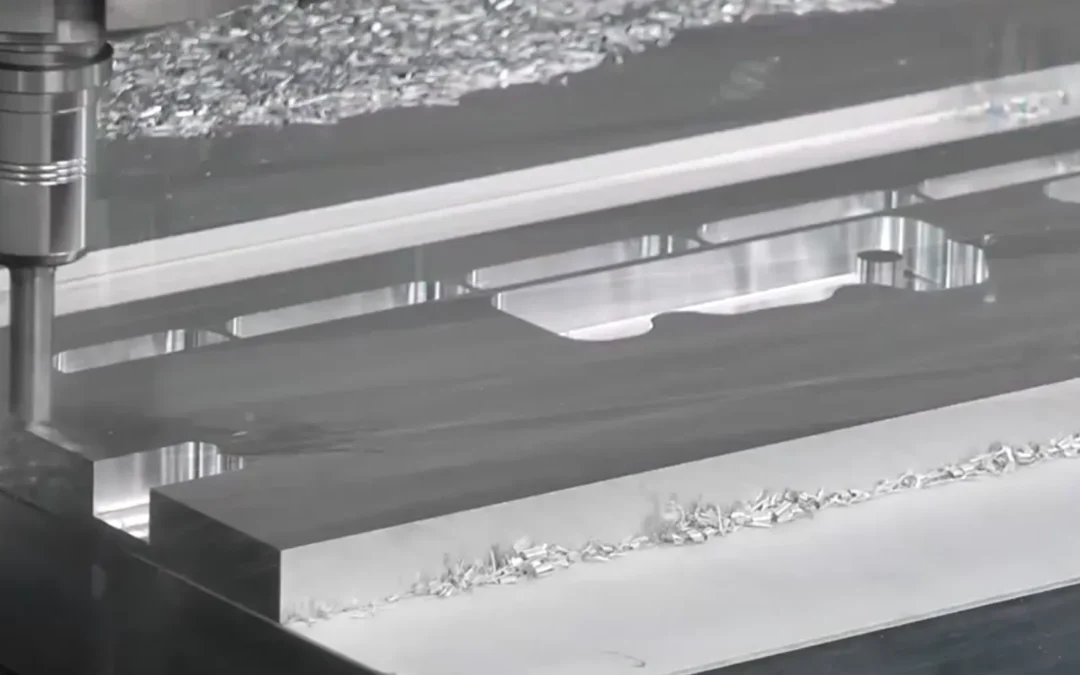
CNC machining for ultra-deep pocket milling applications represents one of the most technically demanding areas of modern manufacturing, where extreme depth-to-diameter ratios, tight tolerances, and complex internal geometries converge in a single operation. Ultra-deep pocket milling is commonly required in aerospace structural components, automotive die and mold manufacturing, energy sector housings, medical equipment frames, and heavy industrial tooling where internal cavities must be both deep and geometrically precise. Unlike standard pocket milling, ultra-deep applications introduce unique challenges related to tool deflection, chip evacuation, heat accumulation, vibration, and tool life instability. As pocket depth increases, the cutting tool becomes more susceptible to bending forces, which directly affect dimensional accuracy, surface finish, and even the structural integrity of the workpiece. Modern CNC machining has evolved significantly to address these issues through the integration of high-speed spindles, rigid machine structures, intelligent toolpath strategies, and advanced cutting tool technology. With the rising demand for lightweight yet structurally optimized components, ultra-deep pocket milling has moved from a specialized niche process into a core capability for high-performance manufacturing across multiple global industries.
One of the most critical aspects of successful ultra-deep pocket milling is cutting tool selection and optimization. Long-reach end mills, extended flute tools, and reinforced shank geometries are essential to access deep internal features while maintaining acceptable rigidity. Tool material selection, such as ultra-fine grain carbide or coated carbide with multilayer thermal and wear-resistant coatings, plays a decisive role in minimizing premature tool failure. At extreme cutting depths, even minimal runout or imbalance can amplify vibration and lead to rapid edge chipping or catastrophic tool breakage. This is why modern CNC machining systems rely heavily on precision tool holders, hydraulic or shrink-fit chucks, and dynamic balancing systems that ensure concentricity at high spindle speeds. Tool geometry must also be carefully engineered, with optimized helix angles and chip breaker designs that promote smooth chip flow in confined cutting zones. In ultra-deep pocket milling, improper chip evacuation is not merely inefficient—it is destructive. Re-cutting trapped chips increases heat, degrades surface quality, accelerates tool wear, and dramatically raises the risk of tool snapping. Therefore, high-pressure through-spindle coolant systems and minimum quantity lubrication strategies are now widely adopted to flush chips from deep cavities and stabilize cutting temperatures.
Machine rigidity and dynamic stability form the mechanical foundation of precision CNC machining for ultra-deep pocket applications. As cutting depth increases, the leverage effect on the tool grows, magnifying even the smallest machine vibrations into measurable dimensional deviations. Advanced CNC machines designed for deep pocket milling feature reinforced column structures, vibration-dampening castings, and precision linear guide systems that maintain stability under high cutting loads. High-torque spindles with wide speed ranges allow operators to balance cutting force and surface speed depending on material hardness and pocket geometry. Thermal stability is equally important, as prolonged deep milling cycles generate significant heat that can cause thermal expansion in both the spindle and the workpiece. Temperature-controlled coolant systems, real-time thermal compensation software, and machine enclosures with environmental regulation are now standard in high-end deep pocket milling environments. These systems ensure that dimensional accuracy is preserved over long machining cycles, which is especially critical for aerospace and energy sector components where tolerances are often measured in microns over depths of several hundred millimeters.
Toolpath strategy is another defining factor that separates average deep pocket milling results from truly high-performance outcomes. Conventional straight-down ramping and full-width slotting strategies generate excessive tool engagement and cutting forces that are unsustainable at extreme depths. Modern CAM software enables advanced high-efficiency milling techniques such as trochoidal milling, adaptive clearing, and constant tool engagement paths that distribute cutting loads evenly along the tool edge. These strategies minimize radial tool pressure, reduce vibration, and maintain consistent chip thickness, allowing deeper cuts with greater process stability. Helical entry moves and progressive depth stepping prevent shock loads on the tool, while optimized step-over values improve both cycle time and surface finish. Rest machining and semi-finishing passes are also crucial in ultra-deep pocket applications, as leaving a controlled amount of stock for final finishing reduces deflection-related inaccuracies. By combining intelligent CAM algorithms with real-time CNC control feedback, manufacturers can achieve deep internal pocket geometries that meet demanding quality standards while maintaining efficient production rates.
Material behavior under ultra-deep pocket milling conditions introduces additional layers of complexity that must be addressed through precise process engineering. High-strength aerospace alloys such as titanium, Inconel, and heat-resistant steels exhibit extreme cutting resistance and poor thermal conductivity, causing localized heat buildup, tool adhesion, and accelerated wear. Aluminum alloys, while easier to machine, present different challenges related to chip welding and surface smearing at high spindle speeds. Hardened tool steels used in die and mold manufacturing require exceptional cutting edge stability and consistent thermal management to prevent micro-cracking and surface burning. As pocket depth increases, the thermal and mechanical stresses become more concentrated within the confined cavity, making conventional cooling methods insufficient. This has driven the widespread adoption of through-tool coolant delivery, cryogenic cooling with liquid nitrogen or carbon dioxide, and hybrid lubrication systems that dramatically enhance heat extraction and chip evacuation efficiency. These technologies allow deeper pockets to be machined with higher cutting speeds while preserving surface integrity and extending tool life, delivering measurable gains in production efficiency and cost control.
Surface finish, dimensional accuracy, and geometric consistency are the ultimate quality benchmarks in CNC ultra-deep pocket milling applications. Deep internal cavities are often functional surfaces that directly influence fluid flow, mechanical engagement, structural stiffness, or thermal dissipation in the final product. Any deviation in wall taper, pocket flatness, or corner radius can compromise assembly fit, load distribution, or system efficiency. Achieving superior surface quality at extreme depths requires a carefully sequenced combination of roughing, semi-finishing, and finishing operations. Ultra-light finishing passes with reduced feed rates and stabilized spindle speeds are commonly employed to remove the final microns of material with minimal cutting force. Tool wear monitoring becomes critical at this stage, as even minor edge degradation can translate into visible surface defects or dimensional drift. Advanced in-process probing systems and post-process metrology tools such as coordinate measuring machines and laser scanners are routinely used to verify internal pocket accuracy. In high-value industries, every deep pocket component is often digitally documented to ensure full traceability, compliance with global standards, and long-term performance reliability.
The future of CNC machining for ultra-deep pocket milling applications is being shaped by the rapid convergence of automation, artificial intelligence, and data-driven manufacturing ecosystems. Smart CNC systems equipped with adaptive control algorithms can now detect changes in cutting force, vibration, and temperature in real time, automatically adjusting spindle speed, feed rate, and depth of cut to maintain optimal machining conditions. Digital twins of deep pocket machining processes allow engineers to simulate tool deflection, chip flow, and thermal behavior before production even begins, drastically reducing setup time and scrap rates. Robotic automation further enhances productivity by enabling continuous unmanned machining of deep-pocket components, even during extended production cycles. As product designs continue to evolve toward lighter, stronger, and more compact structures, the demand for ultra-deep pocket milling will only intensify. Manufacturers that invest in advanced CNC platforms, cutting-edge tooling, intelligent CAM software, and skilled process engineers will gain a decisive competitive edge in producing the next generation of complex, high-performance components that define modern global industry.